
Land Clearing Debris Removal Milledgeville, GA
Trees, brush, and vegetation left after clearing? We handle full haul-off, on-site mulching, or stacking per Georgia Forestry Commission rules — leaving your property clean and ready for its next phase. Free quote with a site visit.
Land Clearing Debris Removal in Milledgeville GA and Baldwin County
After trees and brush are cleared, the debris that remains — logs, limbs, stumps, root balls, and shredded vegetation — must be handled before the property can move to the next phase. How that debris is handled has a significant effect on both the cost and the condition of the land afterward. The right method depends on the property's location, intended use, volume of material, and practical constraints like neighboring properties and road access.
The most cost-effective option for most properties is forestry mulching — a method that processes trees and brush through a grinding head during clearing, reducing all vegetation to a layer of wood chip mulch. No trucks are needed, no haul-off is required, and the mulch layer protects topsoil from erosion while it decomposes. This is particularly appropriate for rural properties, hunting land, agricultural lots, and any property where immediate construction is not planned. For residential lots where construction must begin immediately, full haul-off is often preferred — leaving a completely bare, clean surface ready for grading and building.
Debris stacking for burning is an option for rural properties outside Milledgeville's city limits where burning is permitted with a Georgia Forestry Commission burn permit. This reduces haul-off cost substantially but requires obtaining the proper permit and conducting the burn on a permitted day. The debris handling decision is part of the pre-clearing scope discussion.
Debris Handling Options
Property owners have four main options for clearing debris:
- Haul-off by dump truck — produces the cleanest surface but adds significant cost in truck time and disposal fees
- Forestry mulching in place — typically the lowest total cost option, well-suited to most rural and semi-rural properties
- Chipping and stacking for on-site use — allows wood material to be retained for garden mulch or path surfacing
- Stacking for permitted burning — reduces haul-off cost on rural properties but requires coordination with GFC and compliance with local ordinances
The best method for your property depends on your specific situation — we discuss all options before the clearing begins.
Georgia Burn Permit Rules and Local Ordinances
Georgia law requires a burn permit from the Georgia Forestry Commission for open burning of land clearing debris outside incorporated areas. Burning is prohibited entirely within Milledgeville city limits and other incorporated municipalities. The GFC burn permit can typically be obtained by phone or online on the day of the planned burn, subject to weather conditions and fire danger ratings. Property owners are responsible for obtaining the burn permit and complying with all GFC regulations — we stack the debris in the designated burn area, but the burn itself is the property owner's responsibility.
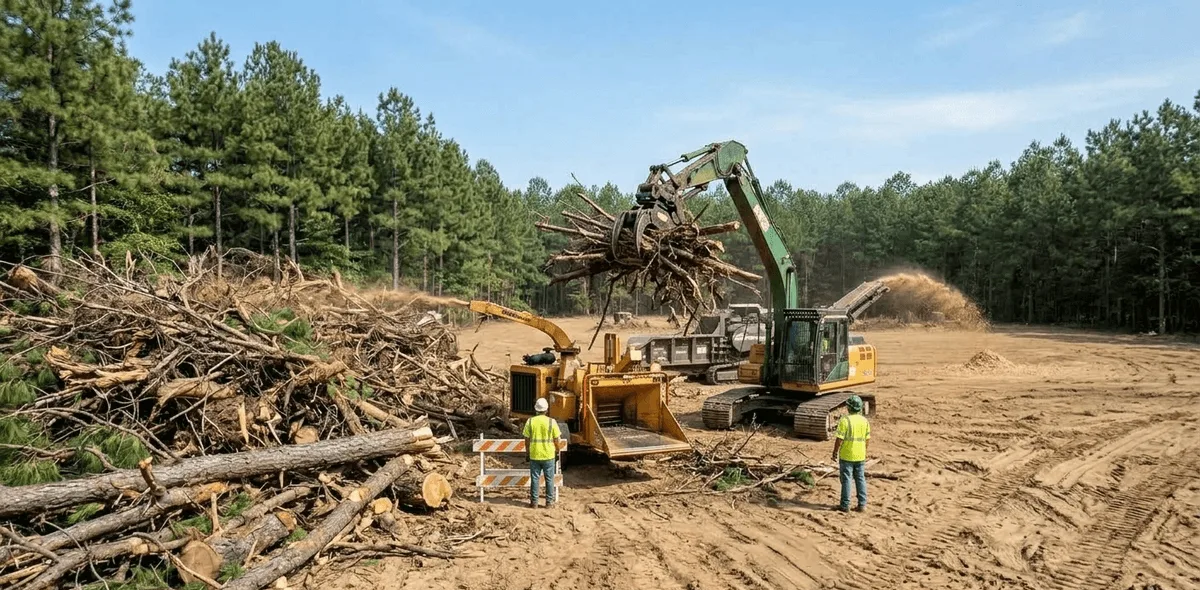
How is cleared debris handled in Milledgeville, Baldwin County?
Cleared debris is handled by full haul-off, forestry mulching in place, or stacking for permitted burning. Georgia Forestry Commission burn permits are required during fire season, and open burning is prohibited within Milledgeville city limits. On-site mulching benefits Cecil series red clay soil by retaining moisture and preventing erosion.
Land Clearing Debris Removal Done Right
Choosing the right debris method before clearing begins prevents extra mobilization costs and leaves the property ready for its next use.
Full Haul-Off Available
Complete haul-off removes all cleared debris from the property by dump truck, leaving a bare, clean surface ready for grading and construction. Ideal for residential lots in developed areas where neighbors are nearby or where immediate construction is planned.
On-Site Mulching Option
Forestry mulching processes debris in place during clearing — no haul-off trucks needed, lowest total project cost, and the mulch layer protects topsoil and reduces erosion. The preferred method for rural properties and any site where immediate construction is not the next step.
Georgia Forestry Commission Compliance
When burning is the chosen method for rural properties, debris is stacked in a designated burn area in compliance with Georgia burn permit requirements. We discuss permit obligations and local ordinances — including the prohibition on burning within Milledgeville city limits — before the clearing scope is finalized.
Clean Property Ready for Next Phase
Debris handling is confirmed before clearing begins so the property is left in the right condition for your next step — whether that is grading and construction, agricultural use, or landscaping. Stump removal in Milledgeville is coordinated alongside debris removal so there are no leftover piles or stumps to deal with.
Our Land Clearing Debris Removal Process
Debris Handling Method Selection
We discuss haul-off, mulching, chipping, or stacking for burning based on the site conditions, your plans for the property, and local burning regulations. The debris handling method is confirmed before clearing begins so equipment and logistics are planned accordingly.
Clearing with Chosen Debris Method
Clearing and debris processing are performed concurrently — no second trip for debris removal when the method is confirmed in advance. Forestry mulching processes debris as clearing proceeds. Haul-off requires loading equipment and trucks staged for debris removal as material is cleared.
Clean Site Delivery
The property is left cleared and clean by the agreed method — including stump grinding and debris removal in Baldwin County GA when stumps are part of the scope. No piles, no unfinished debris handling, no loose material across the cleared surface. The site is ready for the next phase of your project the day we finish.
Debris Removal Cost Ranges
Cost depends on debris volume, chosen method, and haul distance — a site visit gives the most accurate pricing for your project.
On-Site Mulching (Forestry Mulching)
Included in ScopeDebris processed in place with no separate haul-off charge — the lowest total cost option. Mulch layer left on cleared surface for erosion control and soil protection.
Full Haul-Off
$500–$2,500+/loadBased on debris volume, number of truck loads, and haul distance. Most residential lot clearing projects require two to five loads. Leaves a bare, clean surface ready for grading and construction.
Stacking for Burning
$300–$800Debris stacked in designated burn area on rural properties. GFC permit required. Prohibited within Milledgeville city limits. Property owner responsible for conducting the permitted burn.
Get an Accurate Debris Removal Quote
The right debris method depends on location, volume, and your plans — we discuss all options during the site visit.
Request a Free Site QuoteDebris Removal FAQ — Milledgeville & Baldwin County
How is debris handled after land clearing in Georgia?
After land clearing, debris is typically handled one of four ways: haul-off by dump truck, forestry mulching in place, on-site chipping, or stacking for burning with a Georgia Forestry Commission permit.
The right method depends on the property's location, the amount and type of debris, the intended use after clearing, and practical constraints like neighboring properties and road access. We discuss options before clearing begins.
Is burning cleared debris legal in Georgia?
Burning cleared debris in Baldwin County requires a burn permit from the Georgia Forestry Commission for properties outside incorporated city limits. Burning is prohibited entirely within the city limits of Milledgeville and is subject to Georgia's open burning regulations regardless of location. Even outside city limits, burning is restricted during declared burn bans, on days with high fire danger, and when winds exceed permitted levels.
The GFC burn permit is typically obtained by phone or online on the day of the planned burn. Property owners are responsible for obtaining the permit and conducting the burn in compliance with GFC requirements. We stack debris in the designated burn area as part of the clearing scope — the burn is the property owner's responsibility.
How much does debris haul-off cost in Baldwin County?
Debris haul-off in Baldwin County typically costs $500–$2,500 per load depending on debris volume, material type, and haul distance to the disposal facility. Most residential lot clearing projects produce two to five loads of debris — making full haul-off an added cost of $1,000–$12,500 for debris removal on top of the clearing scope.
Forestry mulching is significantly more cost-effective for most Baldwin County properties because it eliminates the haul-off cost entirely by processing debris in place. If your property and intended use are compatible with an on-site mulch layer, forestry mulching is typically the better economic choice.
What is the difference between haul-off and forestry mulching for debris?
Haul-off physically removes all cleared debris from the property, leaving a completely bare surface ready for grading and construction. Trucks are loaded with debris and taken to a disposal facility. The result is a clean, bare site with no vegetation remaining above or on the ground surface.
Forestry mulching grinds all cleared vegetation in place using a forestry mulching machine during the clearing process — producing a layer of wood chip mulch spread across the cleared surface. No trucks are required, haul-off costs are eliminated, and the mulch layer protects the topsoil from erosion while decomposing over time. Forestry mulching is the preferred method for properties where immediate construction is not planned and where the mulch layer is not a problem for the intended use.
Can I keep wood chips from my clearing job?
Yes — if your clearing job produces chipped material, wood chips can be retained on-site for use as mulch around trees, in garden beds, or as a path surface. Let us know before the job begins that you want chips retained, and we will pile them in your preferred location rather than hauling them off or spreading them across the cleared area.
Wood chips from land clearing are typically a mixed species blend and may include some soil and bark contamination — they are generally best used for mulching non-food-garden areas. Chips from pine-heavy lots will have a different decomposition rate and pH effect than hardwood chips, which may matter for specific landscaping applications.
How many truckloads does clearing debris typically produce?
The number of truckloads from a land clearing project depends heavily on the density and size of the vegetation cleared. A lightly vegetated half-acre residential lot might produce one to two loads of debris. A heavily wooded one-acre lot with mature trees and dense understory can produce five to ten loads or more. Large rural acreage with heavy timber can produce significantly more.
Forestry mulching eliminates the truckload calculation entirely because all debris is processed in place — making it the most cost-efficient option for densely vegetated properties where haul-off volume would otherwise drive significant additional cost. The debris volume estimate is one of the factors we evaluate during the site visit when discussing debris handling options with you.