
Stump Removal in Milledgeville, GA
Stumps creating tripping hazards, mowing obstacles, or septic system barriers? We grind them flush or below grade — after tree removal or as a standalone service. Free quote with a site visit.
Stump Removal — Professional Grinding for Local Properties
Many rural properties around Milledgeville, GA carry stumps from prior logging operations — large, weathered remnants of pines and hardwoods cut years or decades ago and never ground. These old stumps create obstacles for mowing equipment, construction vehicles, and utility installation, and their root systems can interfere with septic drain fields and drainage patterns. Stump grinding in Milledgeville addresses them completely, eliminating the obstruction rather than just cutting around it.
A stump grinder works by lowering a rotating grinding head onto the stump and cutting through the wood progressively below grade. The appropriate depth depends entirely on what will be done with the area afterward — mowing clearance requires only 4 to 6 inches below grade, while construction, foundation work, or septic field preparation typically requires 12 to 18 inches below grade to ensure the remaining root mass does not interfere with compaction or drainage.
Stump grinding is available as a standalone service for properties that had tree removal done by a separate contractor or that have old timber harvest stumps. We also offer post-clearing stump packages for lots that have been cleared and need all stumps ground as part of site preparation. Grinding depth, chip handling, and final grade are discussed and agreed before the job begins.
Stump Grinding Depth for Different Applications
The right grinding depth depends on what you plan to do with the area. For mowing and landscaping — where you simply need to eliminate the tripping hazard — grinding 4 to 6 inches below grade is typically sufficient. For driveways, foundation areas, or any construction use, grinding to 12 to 18 inches below grade is standard. For septic drain field areas, the installer typically specifies the required depth.
Stumps from Prior Timber Harvests
Old timber harvest stumps are common on rural properties, particularly on land that has changed hands multiple times without the stumps ever being addressed. Pine stumps retain high resin content for many years, making them harder to grind than fresh stumps. Hardwood stumps may have partially rotted, which can make them easier to grind — but rotted wood can also harbor decay fungi and pest colonies. A site walk to count and assess the stumps is the most accurate way to estimate the scope and cost.
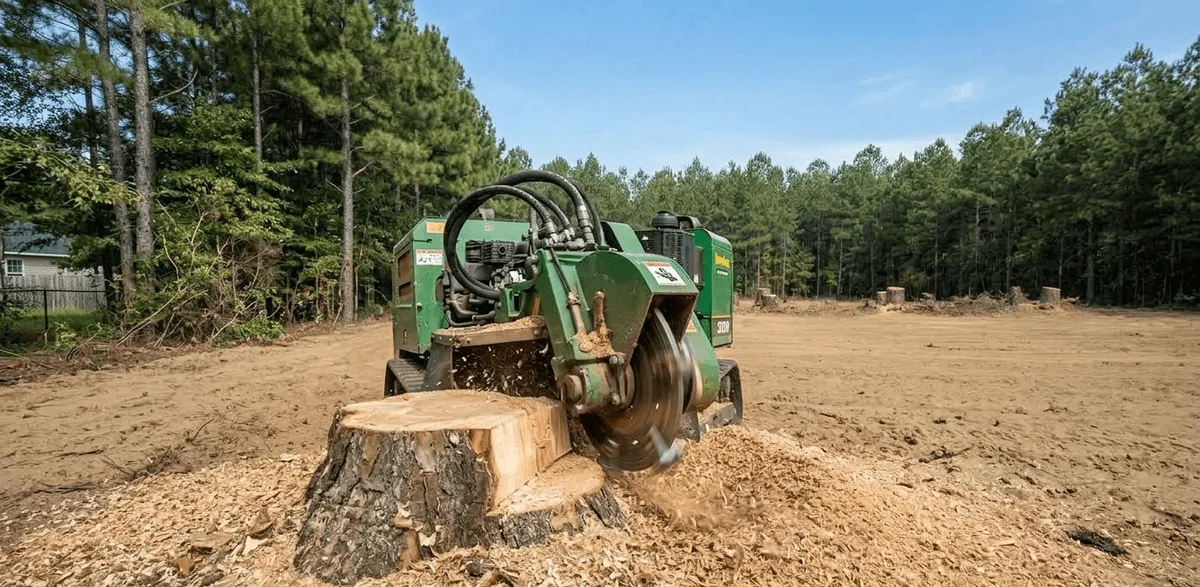
How much does stump removal cost in Baldwin County, Georgia?
Stump removal costs $75–$150 per stump depending on diameter. Cecil series red clay soil holds root systems deep, requiring grinding below grade for mowing clearance or new construction. GFC permits are required before burning removed stumps or debris.
What Stump Removal Accomplishes
Stumps left in place create ongoing obstacles for mowing, construction, and utility installation — grinding removes them completely.
Flush Grade for Mowing and Landscaping
Stumps ground 4 to 6 inches below grade eliminate mowing obstacles and tripping hazards on residential and rural Baldwin County properties — allowing lawn equipment to pass without obstruction and the area to be seeded or sodded over time.
Below-Grade Grinding for Construction
Construction applications — foundations, driveways, and site preparation — require grinding to 12 to 18 inches below grade to ensure the root mass does not compromise compaction, drainage, or bearing capacity in the construction zone.
Eliminates Septic Field Obstacles
Stumps and root systems in planned septic drain field areas must be removed before drain field installation can proceed. Stump grinding to the required depth clears the way for septic installation without the root interference that can disrupt drain lines over time.
Standalone Service — No Full Clearing Required
Stump removal is available as a standalone service for properties with isolated stumps from prior tree removal, old timber harvests, or storm damage — no full clearing scope required. We assess your stump count and access before quoting.
Our Stump Grinding and Removal Process
Stump Inventory and Access Assessment
We count and locate all stumps on the property, assess diameter and species, and evaluate grinder access routes for tight spaces between structures, fences, and preserved trees. Access constraints and grinding depth requirements for your planned use are confirmed before the job begins.
Grinding to Specified Depth
The grinding head processes each stump below grade to the agreed depth — matched to the application. Mowing clearance is 4 to 6 inches. Construction and septic applications are 12 to 18 inches. Large-diameter or difficult-access stumps receive additional passes as needed to achieve the target depth.
Chip Cleanup and Final Grade
Wood chip debris from the grinding head is raked or blown clear of the grinding area. The site is left ready for its intended use — whether that is seeding and mowing, construction grading, or septic field installation. Chip debris can be left on-site as mulch or removed per your preference.
Stump Removal Cost Ranges — Milledgeville & Baldwin County, Georgia
Cost depends on stump diameter, species, access, and quantity — a site visit or stump count gives the most accurate pricing for your property.
Individual Stumps
$75–$150/stumpBased on diameter, species, and access. Minimum service call applies for small quantities. Pricing includes grinding to specified depth and chip cleanup.
Multiple Stumps (5–20)
$60–$120/stumpVolume discount applies on larger quantities — mobilization cost is spread across the job. Access assessment required for tight-space or high-count jobs.
Post-Clearing Stump Package
$500–$3,000+Full stump grinding on a cleared lot following land clearing, priced per lot based on stump count and average diameter. Most efficient when coordinated with clearing scope.
Get an Accurate Stump Removal Quote
Stump count, diameter, and access vary widely — we assess your property before providing a final price.
Request a Free Site QuoteStump Removal FAQ — Milledgeville & Baldwin County
How much does stump grinding cost in Baldwin County, Georgia?
Individual stump grinding typically costs $75–$150 per stump depending on diameter, species, and access. A minimum service call applies for small quantities of one to three stumps. Volume discounts apply on jobs with five or more stumps, bringing the per-stump cost into the $60–$120 range.
Full post-clearing stump packages are typically priced by the lot based on total stump count and average diameter rather than individually. A site visit or stump inventory is the most accurate way to price a job.
How deep should a stump be ground for construction?
For construction purposes — foundation work, driveway installation, or septic drain field preparation — stumps should generally be ground 12 to 18 inches below grade. This depth ensures the remaining root mass does not interfere with compaction, drainage, or the bearing capacity of the soil in the construction zone.
For mowing and landscaping use only, grinding 4 to 6 inches below grade is typically sufficient to allow mowing equipment to pass without obstruction. We match grinding depth to your intended use — let us know what the area will be used for after grinding and we will grind to the appropriate depth.
Can stump grinding damage underground utilities?
Stump grinding can potentially damage underground utilities if the stump is near buried lines and the grinder is taken to significant depth. Before grinding near known or suspected utility locations, we recommend calling 811 — Georgia's free utility locating service — to have underground lines marked before work begins.
We adjust grinding depth and approach when working near utility corridors to avoid contact with buried infrastructure. Most rural Baldwin County properties have stumps well away from utility lines, but suburban and in-town properties require a utility check as a standard precaution before deep stump grinding begins.
Are stumps from old timber harvests harder to grind?
Old timber harvest stumps vary significantly in grindability. Pine stumps retain high resin content for many years after cutting, making them substantially harder and more wear-intensive to grind than fresh stumps of similar diameter. Large-diameter pine harvest stumps — common on rural Baldwin County properties — can take considerably longer to grind than fresh residential tree stumps.
Some older hardwood stumps have rotted to a degree that makes them easier to process — but rotted wood can also be unpredictable in terms of structural integrity during grinding. A site assessment before quoting old timber harvest stump jobs is standard practice, as the per-stump cost can vary significantly based on species, age, and actual condition at grinding time.
Does forestry mulching include stump removal?
Forestry mulching processes trees and brush through a grinding head that reduces them to mulch at or near grade level — but the forestry mulcher's grinding head does not typically go below grade the way a dedicated stump grinder does. Forestry mulching will reduce stumps to ground level or slightly below, which may be sufficient for mowing clearance but is generally not sufficient for construction, foundation work, or septic field installation.
For construction applications requiring below-grade grinding, a dedicated stump grinder is needed to achieve the 12 to 18 inch depth that construction and septic work requires. We can combine forestry mulching with follow-up stump grinding on cleared lots where the depth requirements make dedicated grinding necessary.
How long does stump grinding take?
Individual stump grinding typically takes 15 to 45 minutes per stump depending on diameter, species, and access. A residential lot with 5 to 10 stumps of typical size can usually be completed in a half day. Larger lots with 20 or more stumps, or lots with large-diameter old timber stumps, may require a full day or more depending on access and grinding depth requirements.
Access is often the limiting factor on stump grinding jobs — tight spaces between structures, existing fences, and preserved trees can require significant repositioning time and slow the overall pace of the job. We assess access constraints during the site walk to give you an accurate time estimate before scheduling.
How much does stump grinding cost in Milledgeville, GA?
Stump grinding in Milledgeville, GA typically costs $75–$150 per stump depending on diameter, species, and access, with volume discounts of $60–$120 per stump on jobs of five or more. Milledgeville Land Clearing offers both stump grinding and full stump removal — as a standalone service or bundled with land clearing — throughout Milledgeville and Baldwin County.
A site visit or stump count gives the most accurate price for your specific property.